

Grease Fundamentals
Posted on 09/24/26 in: | Author: Robert Cox, Technical Services Specialist – Whitmore Manufacturing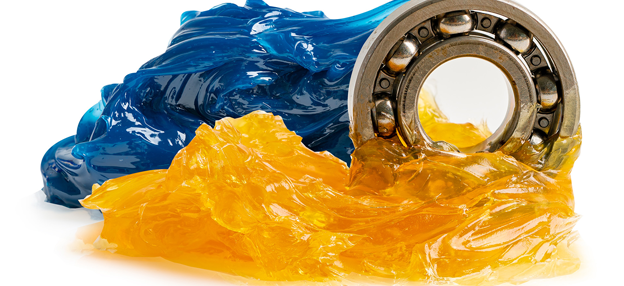
Whitmore Manufacturing offers an extensive range of high-performance greases in our Whitmore, Jet-Lube and Hydrotex product lines that have been used around the world for decades in diverse industries such as: industrial manufacturing, rail transportation, oil & gas extraction, and heavy duty mining.
Understanding the various types of greases and their key properties can help minimize downtime and ensure your equipment is operating at peak performance. Let's dive into the fundamentals of grease and why they are essential to effective lubrication.
_____________________________________________________________________________________
What is Grease?
First, let’s start with the basics - what is grease, and how does it compare to lubricating oil? Greases are in a category of lubricants that can be described as Thickened Lubricants. Fundamentally, greases perform the same functions as lubricating oils, but the lubricant consistency is intentionally thickened to reduce how much the grease will flow.
Formulated lubricants all feature a base oil, most commonly a hydrocarbon oil. Blended into this base oil are additives that enhance the lubricating characteristics of the base oil, such as: wear protection, corrosion protection and resistance to oxidation.
With grease, however, one more component is needed: the thickener. Usually consisting of a metallic soap or oil soluble particulates, the thickener reduces the grease’s ability to flow. You can think of the thickener as an oil-filled sponge, keeping the lubricant where it needs to be and releasing oil when it is needed.
_____________________________________________________________________________________
Why use Grease?
Oil lubrication is often preferred to help dissipate heat and promote cleanliness. However, many equipment and operating conditions benefit MORE from the thickened nature of grease. Examples include:
- Small components that don’t have an oil reservoir or are in a difficult area to service, like electric motor bearings, wheel bearings, and other lubrication points on mobile equipment.
- Components and equipment that cannot adequately seal in a lubricating oil, like open gear sets, wire ropes, and automotive suspension components.
- Components subject to heavy contamination where the grease itself can act as a seal, like pins & bushings on earth-moving equipment, or high-washdown areas in food processing facilities.
_____________________________________________________________________________________
Important Physical and Performance Properties of Grease
For any lubricant, viscosity is the most important property to ensure proper lubrication. A grease’s base oil should be thick enough to separate moving surfaces, but thin enough to penetrate the tight clearances between them. For instance, a low-speed grease will generally feature a heavy viscosity base oil, often around 460 cSt or higher, while a high-speed grease will require a much lighter base oil viscosity, often 100 cSt or lower. Multi-purpose greases will fall somewhere in between, with ISO 220 being a common base oil viscosity grade.
A key property for grease that does not apply to oils, is consistency or firmness. Grease consistency significantly impacts how a grease moves and flows. This is critical to ensure the grease stays in the right place to properly lubricate.
Grease consistency is categorized by the NLGI Grade. The NLGI Grade is a rating scale that spans from 000, which is a very fluid grease, to 6 which has about the same firmness as a crayon.
A soft, or semi-fluid grease is beneficial in cold environments and when the grease is used in centralized lubrication systems. The softer consistency allows the grease to move and flow better in cold temperatures and over long distances. A firm grease is beneficial in high temperature applications or in poorly sealed equipment, to reduce leakage. The optimal firmness of a grease is a balance between adequate flow, and resistance to creep and leakage, with the most commonly used grade being NLGI 2, which is about the consistency of peanut butter.
Other important grease properties include:
- the dropping point, which is the upper operating temperature at which the grease thickener and base oil will separate
- protection against wear
- protection against extreme pressure damage
- corrosion protection for metal surfaces
- resistance to displacement by, and mixing with water
Grease may also contain solid additives such as graphite, molybdenum disulfide and PTFE. Solid additives can increase lubricity and protection against heavy shock loads but may not be appropriate for use in high-speed equipment.
One final important grease characteristic is color. Grease manufacturers will often add dyes or pigment to aid in grease identification and preventing misapplication. But beware, there is no industry standard for grease coloration; grease color does not indicate inherent properties or the type of grease. For example, one red grease may exhibit very different properties and behave entirely differently than another red grease. Always choose your grease based on the right performance properties for the application at hand.
_____________________________________________________________________________________
Different Types of Grease
Now that we have an understanding of grease and its important properties, let’s explore the different types of greases.
Besides base oil and additives, much of the biggest impact on grease performance will come from the type of thickener used. While there is a wide range of thickener types to choose from, the four primary options in use today are:
- Lithium / Lithium Complex
- Aluminum Complex
- Calcium / Calcium Sulfonate
- Polyurea
Lithium
Lithium soap thickened greases offer great performance at a relatively low cost, making them the most popular grease type in the world. Made by reacting lithium hydroxide and 12-hydroxystearic acid, the standard lithium 12-hydroxystearate grease is a soap thickener that holds oil in a fibrous structure. Lithium thickeners are often used for moderate duty multi-purpose greases, such as Jet-Lube's White Lithium Grease; or for heavier duty greases where temperatures are not extremely low or high, such as Whitmore’s Caliber Blue and Caliber XR series.
Lithium Complex
Lithium Complex thickened greases undergo a more complicated chemical reaction, resulting in a denser fiber structure that can handle higher temperatures and shear loading, with greater resistance to oil bleeding and water contamination. This makes them excellent candidates for high temperature and high-speed applications such as electric motors and disk-brake wheel bearings. Jet-Lube's Jet-Red and Jet-Plex EP are ideal examples of high-performance lithium complex greases. When combined with molybdenum disulfide solid lubricants, lithium complex is also the thickener of choice for most mining, construction and earthmoving equipment. Whitmore's Caliber 3M and 5M greases are formulated with 3% and 5% molybdenum disulfide respectively, to protect against the most extreme shock loading.
While Lithium greases offer strong performance in most applications, there are certain applications and scenarios where other thickener types shine, and with the accelerated adoption of lithium batteries, supply chain issues have begun to impact the cost-efficiency of lithium greases. Therefore, it is important to understand the alternative grease thickener types as well.
Aluminum Complex
Aluminum Complex thickeners offer many of the same advantages as lithium complexes but generally offer even more water resistance and the ability to be rated as “food grade” where incidental contact with food is possible. However, aluminum complex greases struggle with low temperature pumpability and are prone to hardening and cracking when stored for long periods. Whitmore offers a range of aluminum complex options, including our Jet-Lube Alco-EP heavy duty greases, and our Hydrotex Ultra-Kleen 550 series of food grade greases.
Calcium
Calcium soap is one of the oldest thickener types, dating back to as early as 1845. Used primarily as a “cup grease” in wagon wheel hubs, it has fallen out of favor. It’s successor, calcium-complex, is likewise rarely used today, usually combined with lithium as a water resistance enhancer. However, the calcium sulfonate thickener type has found widespread and growing utility.
Calcium Sulfonate
Unlike the sponge-like fiber structure of a soap thickened grease, calcium sulfonate greases are particle thickened, with the calcium sulfonate particles imparting both natural extreme pressure protection and unparalleled protection from water and corrosion. Designed for the most severe loads and operating conditions, Whitmore offers the Matrix EP and Jet-Gold EP series, as well as the Hydrotex Ultra-Kleen 540 food grade series.
Polyurea
Similar to calcium sulfonate, polyurea greases are particle thickened. Polyurea molecules are structured very similarly to anti-oxidant additives, giving polyurea greases a natural resistance to oxidation and thermal breakdown. These are generally separated into two groups: the “shear stable” di-urea greases, which are commonly used in electric motors, and the “non-shear stable” tetra-urea greases, which are specified in certain high temperature, heavy duty applications. While popular in certain places like Japan, polyurea greases require dangerous chemicals to produce, making them less popular worldwide except where required. Whitmore’s Hydrotex brand offers a high performance, shear stable polyurea electric motor grease, Polygard EM.
_____________________________________________________________________________________
The Bottom Line
Choosing the right grease enhances performance, reduces maintenance costs, and keeps your equipment running and lasting longer. Remember, there is no industry standard for grease coloration. Always choose your grease based on the right performance properties for the application at hand.
Need help finding the right solution for your operation? Our experts are here to help.
📩 Contact us here
Featured Greases:
Lithium
- Jet-Lube: White Lithium Grease
- Whitmore: Caliber Blue
- Whitmore: Caliber XR
Lithium Complex
- Jet-Lube: Jet-Red
- Jet-Lube: Jet-Plex EP
- Whitmore: Caliber 3M and 5M
Aluminum Complex
- Jet-Lube: Alco-EP
- Hydrotex: Ultra-Kleen 550
Calcium Sulfonate
- Whitmore: Matrix EP
- Jet-Lube: Jet-Gold EP
- Hydrotex: Ultra-Kleen 540
Polyurea
- Hydrotex: Polygard EM
___________________________________________________________________________________
About the Author
Robert Cox is a trusted expert in performance lubricants and industrial reliability with a passion for helping companies maximize equipment performance and improve operational efficiency.
_____________________________________________________________________________________
Watch Robert explain these key points in the video below.